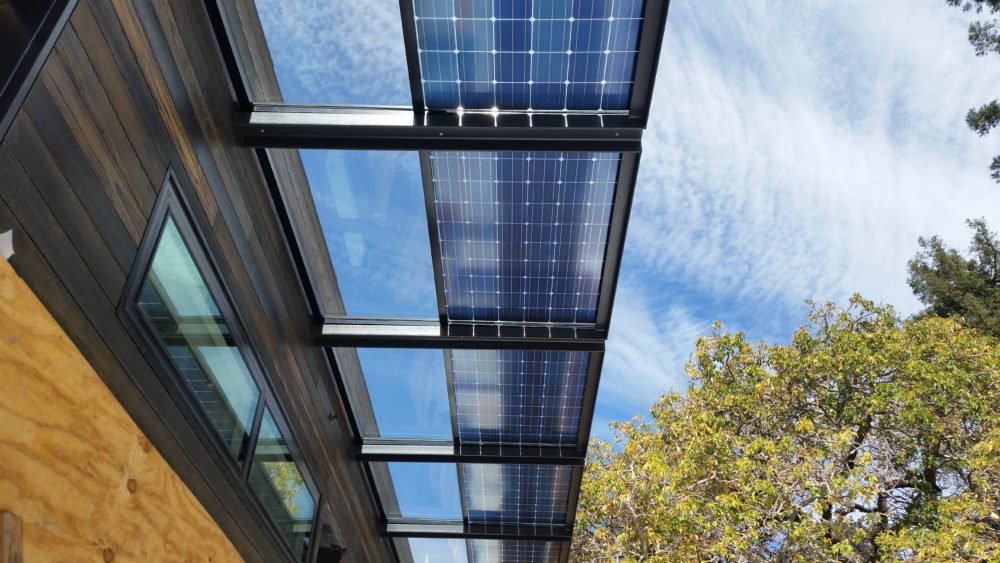
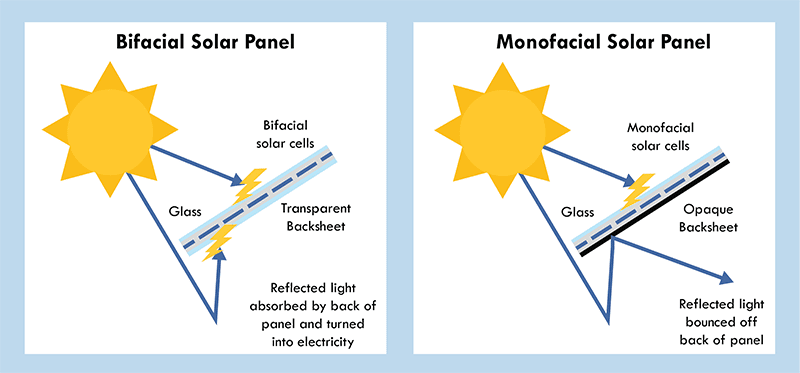
Bifacial modules produce solar power from both sides of the panel. Whereas traditional opaque-backsheeted panels are monofacial, bifacial modules expose both the front and backside of the solar cells. When bifacial modules are installed on a highly reflective surface (like a white TPO roof or on the ground with light-colored stones), some bifacial module manufacturers claim up to a 30% increase in production just from the extra power generated from the rear.
Design
Bifacial modules come in many designs. Some are framed while others are frameless. Some are dual-glass, and others use clear backsheets. Most use monocrystalline cells, but there are polycrystalline designs. The one thing that is constant is that power is produced from both sides. There are frameless, dual-glass modules that expose the backside of cells but are not bifacial. True bifacial modules have contacts/busbars on both the front and back sides of their cells.
How are bifacial modules installed?
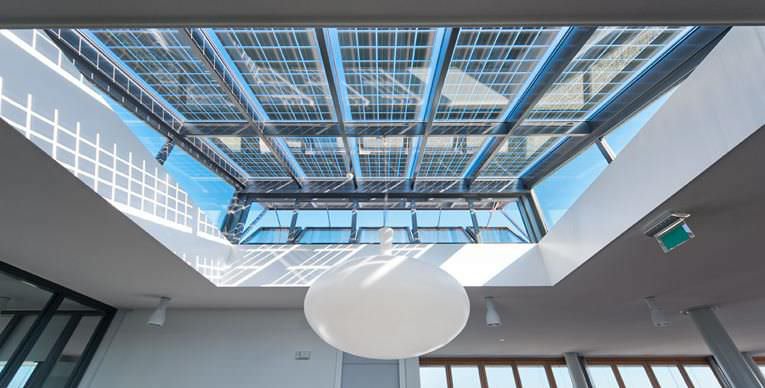
The way a bifacial module is mounted depends on its type. A framed bifacial module might be easier to install than frameless, just because traditional mounting and racking systems are already adapted to framed models. Most bifacial module manufacturers provide their own clamps to mount their specific brand, taking away any installation hesitations
The way a bifacial module is mounted depends on its type. A framed bifacial module might be easier to install than frameless, just because traditional mounting and racking systems are already adapted to framed models. Most bifacial module manufacturers provide their own clamps to mount their specific brand, taking away any installation hesitations.
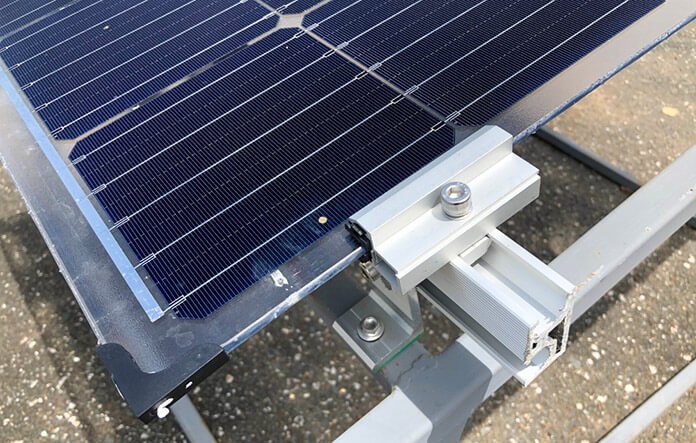
For frameless bifacial modules, the module clamps will often feature rubber guards to protect the glass, and special care must be taken to prevent overtightening bolts and damaging the glass.
The higher a bifacial module is tilted, the more power it produces from its bifacial properties. Bifacial modules mounted flush to a rooftop block any reflected light from reaching the backside of the cells. That’s why bifacial modules perform better on flat commercial rooftops and ground-mounted arrays, because there is more room for tilt and bouncing reflected light to the rear of the modules.
The mounting system itself can affect the performance of the bifacial modules. Racking systems with support rails usually covered by a monofacial module’s backsheet will shade back rows of bifacial cells. Junction boxes on bifacial panels have become smaller or separated into multiple units positioned along the panel’s edge to prevent shading, too. Mounting and racking systems specially formatted for bifacial installations take out the question of backside shading.
What is the outlook for bifacial modules?
The challenge with bifacial has always been the unpredictability of the power output because it’s dependent upon the substrate behind the modules—a white commercial roof, a dark comp shingle, grass, gravel. It’s hard to model what the module is going to produce. The financing community is coming around on bifacial and the cost structure is coming down. We’ll be hearing more about that technology in the coming two or three years. https://pagead2.googlesyndication.com/pagead/js/adsbygoogle.js?client=ca-pub-2829972634513519
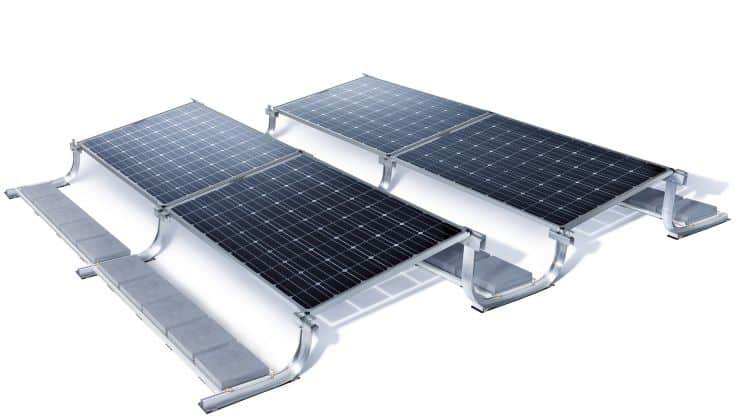
Bifacial modules are the future of the industry. It inherited all the advantages of mono PERC modules: high power density resulting in significant BOS savings, high energy yield with better low light performance and lower temperature coefficient. In addition, bifacial PERC modules also harvest energy from the rear side, demonstrating higher energy yield. We think bifacial PERC modules are the best approach to realize lower LCOE.
Advantages of a Bifacial Solar Panel
Bifacial solar modules provide absolute benefits over regular solar panels:
- Better execution
- Higher productivity
- More prominent profitability
- Tantamount expense with the standard ones
- Better than utilizing trackers
- More sturdy
- Saves space
Efficiency Comparison
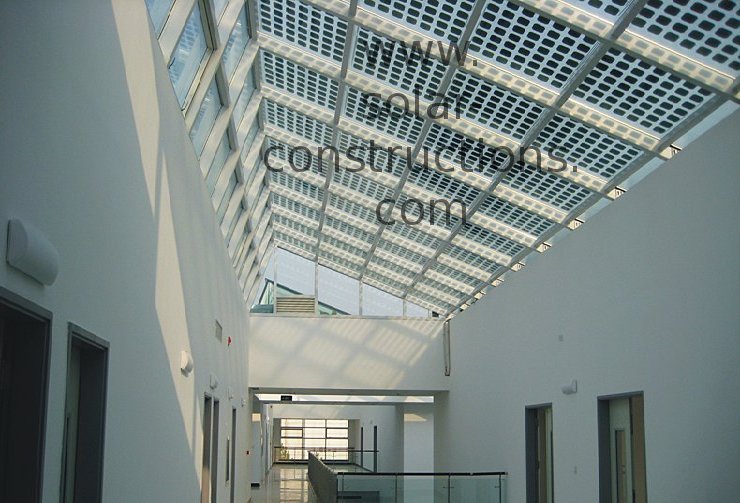
The bifacial solar panels have the capacity to manufacture electricity from both sides and this is due to the reason that they have glass covers on both the upper and back sides. This additionally makes them relatively more profitable and productive than their counterparts.
Are Bifacial Solar Panels Right For Your Home?
Bifacial solar panels are on the ascent and have been in utilization for as long as a couple of years. However, relatively few private residential solar systems have had them being used. These panels have generally been utilized in large commercial establishments with space limitations. Altogether, these solar panels are an incredible decision for solar systems across Pakistan. The greater part of the rooftops in Pakistan have cement, concrete, or block rooftops which are not the proper reflective material for these panels but rather they at any rate increase the profitability. The marble rooftops or white painted rooftops are the finest establishments for the installation of these solar plates.

 Design and Build Data